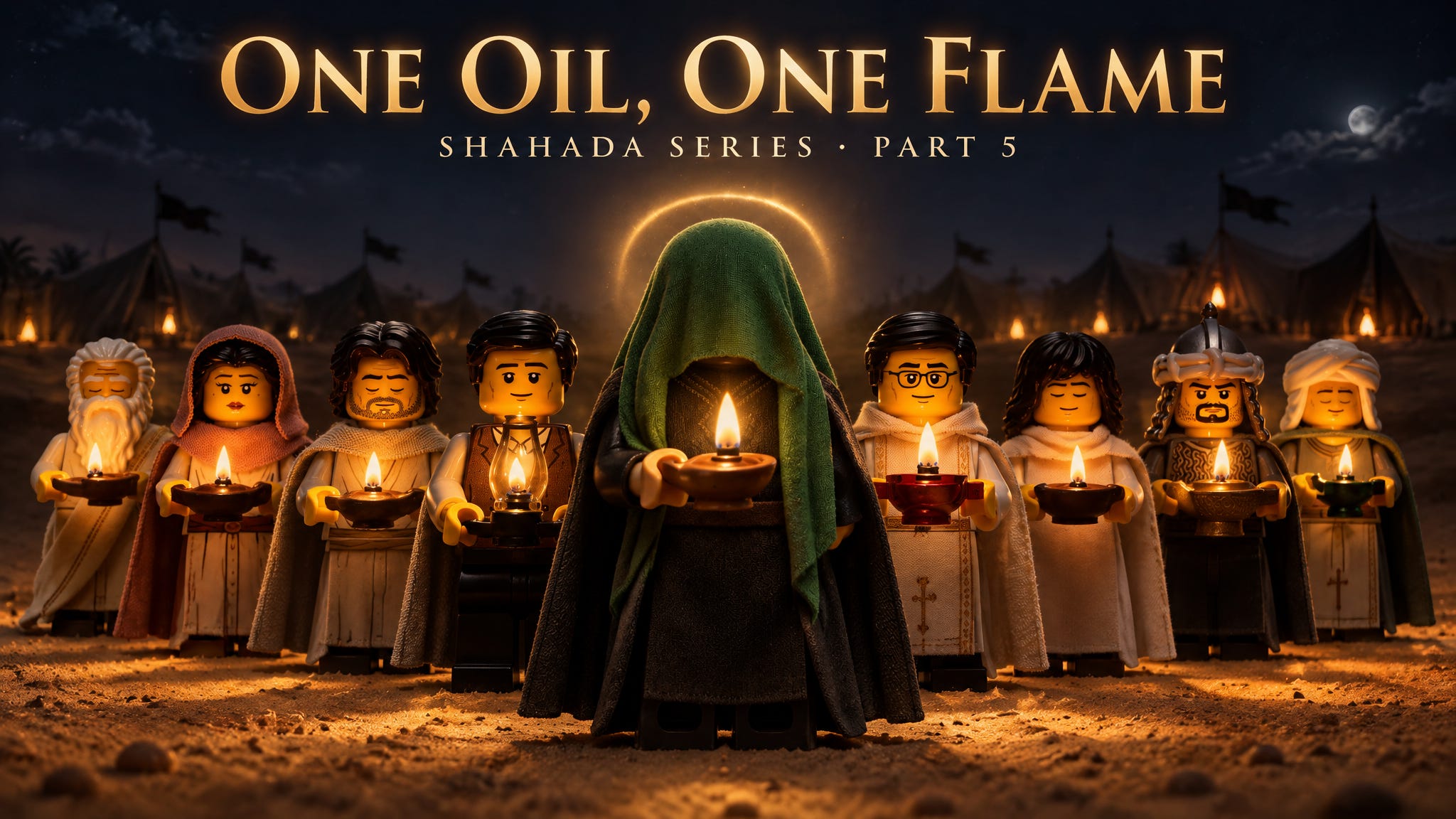
This track is a companion track, and each of its lines is built from the series of sessions developed by the Truth Promoters Group for Muharram (Ashura) 1448 (June 2026) and Safar (Arbaeen) 1448 (July/August 2026).
It is the fifth in our series, following Where Is Your Brother, Am I Not Your Lord?, Twelve Words and Every Day Is Ashura. The first four stayed inside the family of the Prophet and its story. This one steps outside it for the first time — to witnesses who spoke another language, carried another book, and gave the same thing.
Each of the verses encapsulates the lessons of Session 5 of the Shahada (Witness) Series — The Cross and the Witness — and of the maqtal recited that same night: Hurr ibn Yazid al-Riyahi, and Wahab ibn Abdullah al-Kalbi al-Nasrani.
The relevant sermon and maqtal links are provided alongside each verse.

────────────────────────
A man asked for martyrdom. The Imam did not refuse —
he corrected the man’s grammar.
The faithful one is already a witness.
You have already said the word.
SESSION 5 — the grammar correction. The night opens on a small exchange that carries the whole of it. A man came to Imam al-Sadiq and asked him to pray that he be granted shahada. The Imam did not refuse the prayer. He corrected the sentence: the faithful one is already a witness.
That reframes everything that follows. Shahada is not something you are waiting to be given at the end of your life. It is something you are already doing, or failing to do, with the life you have. You have already said the word. The question is whether you are living it.
They brought the old man to the fire. The proconsul named the price:
one pinch of incense, one short word, and he could walk away.
He did not rage. He counted — eighty-six years, he said,
and he has never done me wrong. So what is there to say?
SESSION 5 — Polycarp of Smyrna. An old bishop of the second century, brought before the Roman proconsul and offered a way out: burn a little incense to the emperor, say one short sentence, and go home.
His answer is the one the song keeps. He did not rage and he did not argue. He counted: eighty-six years he had served his Lord, and in all that time his Lord had done him no wrong — so how could he speak against Him now? A political demand, answered with a piece of accounting. And the accounting turned out to be the whole argument.
A girl of twenty-two in Carthage with an infant at her breast
gave the court two words in Latin, and she would not take them back.
A philosopher in Rome who said no sound mind ever moves
from the truth into the error — only ever the other track.
A farmer with three daughters who refused to swear the oath;
a bishop with the chalice raised, shot down before the wine.
Four empires, four centuries, four languages, one act —
and the word they used for all of them was the same word as mine.
SESSION 5 — the roll call. The sermon walks through witnesses across nineteen centuries, and the song keeps four.
Perpetua, a young mother in Carthage, whose father begged her at the bars of the court to recant, and who gave the magistrate two words — I am a Christian — and would not take them back. Justin, the philosopher in Rome, who held that no one of sound mind moves from truth into error, only ever from error toward truth. Franz Jägerstätter, an Austrian farmer with three small daughters, who in 1943 refused to swear the oath to Hitler and was executed for it. Óscar Romero, the archbishop of San Salvador, shot at the altar in March 1980 as he raised the chalice.
Four empires, four languages. And the sermon’s quiet observation is that every one of them would have recognised the word we use for what they did.
In Greek they said martys. In Arabic, shahid —
one word, two tongues, one deed.
SESSION 5 — the word itself. Greek martys, Arabic shahid, Latin testis: three languages arriving independently at the same meaning — the one who stands in court and tells the truth, whatever it costs.
The English word “martyr” comes from the Greek, and it originally meant nothing more than a witness. The word for dying came later, because so many of the witnesses died.
One oil, one flame,
one light in every hand;
they called it by another name
in every tongue and land.
One oil, one flame.
SESSION 5. The chorus is deliberately shaped like a hymn — the one place in the song where the music turns toward the tradition it is honouring. One oil, many lamps. The vessel changes with every century and every language. The flame inside it does not.
Twenty-one upon a beach in Libya, in a line;
Twenty were Egyptian, and the last was not their own.
They offered him his life back — he had only to deny.
Their God is my God, he said. And he would not go alone.
The world had watched the footage and forgotten it by dawn.
The seminary down at Qom would not let the matter be.
They named them Christian martyrs. They named each of the names.
They honoured what was honourable — and they left them Christian. Free.
SESSION 5 — the twenty-one. In February 2015, twenty-one men were killed on a beach in Libya: twenty Coptic Christians from Egypt, and one man from Ghana, Matthew Ayariga, who was not one of them. In the accounts of that day he was offered his life if he would say he did not share their faith. His answer is the line the song keeps: their God is my God.
The world watched, and filed it, and moved on. The sermon notes that the seminary at Qom did not — it condemned the killing and named them for what they were: Christian martyrs.
And that last word is the point. They were honoured as Christians. Nobody tried to make them anything else.
And here’s the line. We honour them. We do not blur the line.
Five times the Book has said it: no one bears another’s load.
Nobody is born in debt. No child inherits guilt.
And no one — not Husayn himself — can walk for you the road.
The candle shows you how to burn; it does not burn for you.
The flame is catching, but the flame is never given away.
Honour them entirely — and do not call them ours.
Both halves, or neither. That is all that we can say.
SESSION 5 — where the roads part. This is the turn in the night, and the sermon does not soften it.
Five times the Qur’an says the same sentence: no bearer of burdens shall bear the burden of another. No soul carries the sin of another, and no one can carry yours for you. Every child is born on the fitrah — sound, owing nothing, with no inherited debt to be paid.
So our martyrs do not atone for us. They testify. The sermon’s image is the one the song turns on: the candle does not relieve us of the duty to burn — it shows us how to burn. The flame is contagious. It is not transferable.
Which is why the honour has to be given whole, and the distinction has to be kept whole too. Tabyeen means both at once. Praise without the distinction is sentimental; the distinction without the praise is cold. Both halves, or neither.
A captain in the wrong army with a thousand at his back,
a wage, a tribe, a reputation, orders in his hand.
Another man was offered Rey to go and lead the killing —
he took it, and he chose the fire, and he let the order stand.
But the captain shook till morning. Then he turned his horse around
and crossed the open sand with his shield laid upside down.
And Husayn said: God has taken it. Your mother named you right.
You are Hurr. You are free. Now stand here in the light.
MAQTAL 5 — Hurr ibn Yazid al-Riyahi. He was the commander who first stopped the Imam’s caravan, at the head of a thousand horsemen, with everything a man could want: rank, pay, a tribe behind him.
Beside him, Umar ibn Sa’d was offered the governorship of Rayy to lead the killing, and took it. Same plain, same night, opposite choices.
Hurr spent the night shaking. When he was asked why, he said he was choosing between paradise and the fire. At dawn he turned his horse, crossed to the Imam’s camp, and came in with his shield turned over — the sign of a man coming in peace and in repentance. The Imam received him and gave him his own name back: you are free, as your mother named you.
A Christian on the Kufa road, his mother at his side:
go and help the son of Ali — go, and do not count the cost.
He did not leave his truth behind. He crossed into the whole of it.
They walked to Karbala together. And on Ashura he was lost.
They sent his head back to the camp the way you’d send a gift.
His mother took his sword up, and she turned to go as well.
The Imam held her where she stood. He told her: you will walk
with the Messenger of God. And that is all I have to tell.
MAQTAL 5 — Wahab ibn Abdullah al-Kalbi al-Nasrani. A Christian of the tribe of Kalb, who came to Karbala with his mother and his wife. It was his mother who urged him to help the son of Ali.
The song’s central line about him is the sermon’s: he did not leave his truth behind. He crossed into the whole of it. What he believed about God did not have to be abandoned to stand with the Imam; it found where it had been pointing.
He was killed on Ashura, and his head was thrown back into the camp. His mother took up his sword to follow him. The Imam stopped her — and told her that she and her son would be with the Messenger of God.
Can you honour what is true in them and never make it less?
Or must you put a stranger’s candle out to feel your own?
Husayn put nobody’s out — he quoted them at Mina.
He honoured what God honoured. And he left the rest alone.
One oil, one flame!
(it was never only ours)
One oil, one flame!
(and it was never ours to give)
SESSION 5 — the question at the end. The sermon closes on a test for the listener, and it is harder than it sounds: can you honour what is true in another tradition without needing to shrink it? Or does your own faith only feel safe when someone else’s candle has gone out?
The answer the song gives is the Imam’s own example. At Mina, a year before Karbala, he opened his indictment of the silent scholars not with a verse about Muslims, but with one about an earlier people — those cursed on the tongue of David and of Jesus son of Mary. He took another community’s scripture as his witness. He did not need to diminish it to make his case. He stood on it.
He honoured what God honoured. And he left the rest alone.
We believe in blending original, human creativity with the latest digital tools to bring these historical stories to life in new ways.
Lyrics & Concept: 100% original, written by our human team, based on the sermons and maqatil indicated alongside each of the verses.
Music & Vocals: Composed and generated using Suno AI.
Visuals & Animation: Lego-style cinematic scenes generated and meticulously montaged using AI visualisation tools by our team.
A note on the visuals: Out of respect, this animation never depicts the faces of the Prophet Muhammad (S) or the Ahl al-Bayt (AS). Imam Husayn (AS) appears with his face unshown throughout. The twenty-one martyrs of Libya are shown as the Coptic Church depicts them, in their orange garments — standing, at dawn, with no captors in frame. No death is depicted anywhere in this film: Polycarp’s fire is light, Romero’s shooting is a raised chalice, and Wahab’s death is a cloth in the dust.